About this medicine
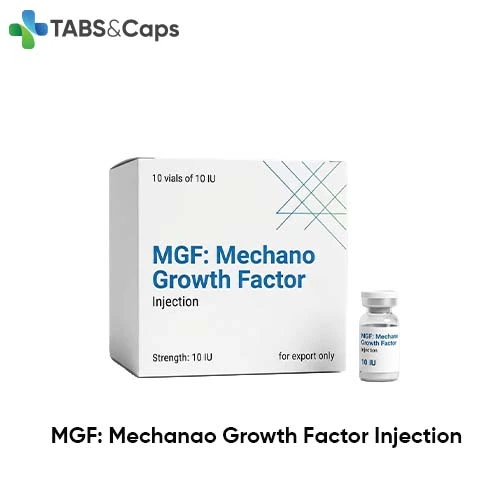
MGF Mechanao Growth Factor Injection
MGF (Mechano Growth Factor) Injection: What It Is, How It’s Studied, and What the Research Says
If you’ve read anything about muscle recovery science, you may have come across MGF, or Mechano Growth Factor. It has an interesting backstory: it’s linked to a substance your own muscles make when they’re worked hard or damaged. Here’s a clear look at what MGF is and where the science actually stands.
What Is MGF?
Mechano Growth Factor (MGF) is a peptide related to insulin-like growth factor 1 (IGF-1). The IGF-1 gene can be “spliced” in different ways, producing slightly different versions of the protein. The main version circulates in the blood and is mostly made by the liver. Another version, known as IGF-1Ec in humans, is produced locally in muscle tissue in response to mechanical stress, such as stretching, heavy exercise or injury. That’s where the name “mechano” comes from.
Synthetic MGF is usually a short peptide based on the unique tail (E-domain) of this IGF-1 variant. A modified version called PEG-MGF (pegylated MGF) is also sold. It’s designed to last longer in the body.
How Is MGF Thought to Work?
The theory behind MGF is linked to how muscles repair themselves. Muscles contain reserve cells called satellite cells. When a muscle is damaged, these cells wake up, multiply and help rebuild the tissue. Researchers have proposed that MGF may:
Activate satellite cells after muscle stress or injury
Support the early stages of muscle repair, before the main IGF-1 takes over
Play a role in tissue protection in other organs. This has been studied in lab models of heart and nerve tissue.
What Does the Research Actually Show?
This is where it’s important to be honest. The evidence on MGF is mostly laboratory-based: cell cultures and animal studies. Some studies reported positive effects on muscle cells, while others found no clear effect at all. Scientists still debate whether the MGF peptide actually works as a separate signal in the body, or whether full-length IGF-1 does most of the job.
There are no completed human clinical trials proving that MGF injections build muscle or speed up recovery. MGF is not an approved medicine in any major market.
Safety Considerations
Because MGF hasn’t been properly tested in people, its long-term safety is unknown. General concerns with growth-factor peptides include:
Unwanted growth signalling: in theory, this could affect abnormal tissue growth
Blood sugar effects: linked to the IGF-1 pathway
Injection-site reactions and infection risk
Product quality: many products are sold online with no guarantee of purity or correct strength
Sport and Legal Status
MGF is prohibited by the World Anti-Doping Agency (WADA) at all times, both in and out of competition. Competitive athletes should avoid it completely.
Why Quality Matters
If MGF is being used for laboratory research, choose suppliers that provide:
A third-party Certificate of Analysis (COA)
Verified purity, ideally 98% or higher
Lyophilised (freeze-dried) vials with proper cold-chain storage
Clear batch numbers and labelling
The Bottom Line
Mechano Growth Factor is a genuinely interesting part of muscle biology and an active area of research into how the body repairs itself. For now, though, the science is early and the evidence in humans is missing. Always talk to a qualified healthcare professional before making any health decisions.
This information is for general reference only. Please use this medicine only under the guidance of your doctor, and share your prescription with us when you order.


.webp)